Rose in front garden bed.
Sunday, June 20, 2010
Wednesday, June 9, 2010
Three Spray Bottles
Fertilizer (Worm Tea), Insecticide (Neem oil, dish soap, and water), and de-chlorinated water (left outside for 24 hours, the chlorine evaporates) can all be mixed in and dispensed from three separate spray bottles. I purchased mine at Home Depot for about $2.00 a bottle and they are really effective. You should also plan on getting a 2 gallon watering can that has a spigot that creates a gentle shower as opposed to a hard stream of water so that you do not damage any leaves or buds. I tend to mist either every day or every other day depending on the heat, and always in the morning to give the plant time to dry before nightfall. Neem oil can be used when you see bug activity or once a week, which ever occurs first. Watering schedule might need to be stepped up to two times a week especially if you have your plants outside, and if you can, use rainwater to water them, they love it.
Light wise, try to keep your orchids out of the direct midday sun as the plants can get sunburned just like us. They really like early morning light, and can tolerate late afternoon sun without burning. If you see bright yellow or brown spots on the leaves or the leaves start to wither and pucker, then you need to get them into a cooler climate. The nice thing about keeping your plants outside is that they get the temperature differential between day and night of about 15 degree's that stimulates the orchids bloom cycle. It is a delicate balancing act though, and you need to check in on them every other day, to make sure they are handling the extra heat and dryness. Now in Houston, Miami, or similar climates, dryness is one thing you won't have to worry about.
Till next time, happy blooms!
Brandon Abshire
The Orchid Whisperer
Monday, May 24, 2010
Watering increase as the mercury rises
Summer has hit the South Texas region with daytime temperatures in the mid to upper 90's! YUCK! Some species like Vandas can handle 90 degree weather, provided the humidity levels are 80-90% as well. All your other plants should be either indoors are on a covered patio where they get protection from the midday sun. Early morning and late afternoon direct sun can be tolerated by orchids, however the increase in lighting should be gradual, and you should definitely watch the leaves for signs of sunburn. Yes, orchids can get sunburned and is displayed in discoloration of the leaves (black or yellow spots). The leaves are a great indicator of whether your orchids are getting too little or too much sun. Too little sunlight and most leaves will be a dark green shade, too much and yellow , brown, or reddish green leaves will appear. For most types of orchids, your leaves should be a yellowish green shade with minimal spotting. Now, some types naturally have small black spots on the leaves, but you will totally notice the difference between natural spots and sunburn spots. A good rule of thumb is if your skin would get a sunburn in a certain location, so would your orchid. Like I have said before, orchids are easy because they pretty much like the same environmental conditions as we do! As always, I await your questions.
Brandon Abshire OW
It is blooming season at Abshire's Orchid Garden! Picture of my newest Cymbidium in yellow.
Saturday, May 15, 2010
Home made Humidity tray
Before you rush out onto the internet and buy a humidity tray for your indoor orchids and plants, I came up with a pretty inexpensive solution and want to pass it along. If you have only a single orchid or 10, the humidity levels in and around the orchids should be somewhere in the 65%-85% range. This can be done very cheaply and easily. In conjunction with humidity levels, orchids also need air circulation to really thrive. So, I have a small fan that blows across my home made humidity tray and takes care of all my humidity and air circulation at once. All you need to do is use the top of a large storage container, make sure it is at least two inches deep, and fill it up with regular tap water and place it near your orchids. I think I got a large storage container at home depot for about $7.00 and use the actual container for well....storing things, only the top is needed for the humidity tray. I priced other solutions online, and some sold for as high as 65 for a tray about 15" by 15". Now for a professional grower with several hundred orchids, I see how this humidity trays would be essential within a rack shelving system with running water etc. all the bells and whistles. But for the casual grower, it is just a waste of money. Now if money is not an issue, then yes, they are much more aesthetically pleasing than my big yellow storage container top, but they do exactly the same job. With that said, mine currently serves 17 orchids that are all clustered around it, and I have about 14 more orchids on their way to my home, so I am going to get a small fountain that recirculates water and place it in the greenhouse I eventually will have to build or purchase. Well, thanks for listening, and I hope this helps. Don't hesitate to tell your friends about this blog!
The Orchid Whisperer
Brandon Abshire
Happy Blooms!
www.royalorchidclub.com This is a site that sells orchids via EBAY, very addictive, because they have some superior deals!
Thursday, May 6, 2010
Cutting a Phalaenopsis
After your phalaenopsis has bloomed and hopefully remained in bloom for 90 or more days, the blooms will wither and die. Don't despair. It is simply time to cut the inflorescence and the orchid will generate a new one from that spot where you cut it. You will need to have some really sharp pruning shears and that is all. First, sterilize your shears with a lighter or even rubbing alcohol, you don't want to transfer any disease from one plant to another. Allow the shears to cool or alcohol evaportate, then locate the bump or node on the flower stem that is just below the lowest flower on the inflorescence. Now cut the stem about 1/4 of an inch above that first node. In a matter of weeks, you will notice that the stem will begin growing from that exact spot, and will need to be staked close to the new growth. Be ready for new blooms. Every third time you do this, you might want to consider resting your orchid and allowing some energy to be diverted to leaf and root growth. Blooming over and over can exhaust your orchid, and make it susceptible to disease. When making a resting cut, you will need to take the orchid completely out of the potting medium, inspect the roots, cut off any foul smelling or unsightly (brown and mushy), and cut the inflorescense at the rhizome or root ball. Since it will be covered in potting medium, after you cut the stem, make a little paste of cinnamon and water and spread that mixture on the cut. This will prevent any disease or critters from entering the rhizome from your cut. Hope that helps!
The Orchid Whisperer
New Yellow Dendrobium
Wednesday, May 5, 2010
Orchid pests
Well, sitting here typing and noticing a tiny gnat like insect buzzing around aimlessly; it must mean it is time to spray the orchids with a neem tree oil extract mixed with dish soap, and water to erradicate these orchid pests. Yes, orchids have a host of pests they are susceptible to including my favorite (sacrasm) thrips. Although I despise thrips, I hate scale and mealy bugs even more. Thrips are long gnat like bugs that fly and generally feed on new growth including flowers. Neem oil is one of five solutions including: Horticultural Oil (try not to use dormant oils, Sunspray Ultra fine is better because it is thinner), Insecticidal soap, Malathion, and Orthene. I prefer neem tree oil because it is a natural chemical, and can be used at full strength without damaging plants, you can even spray on active blooms and not worry about it. Neem oil has a bunch of other uses such as a lotion for dry skin, shampoo, and soap. http://www.neemtreefarms.com/ Check them out and shipping is very reasonable. I just mix about an ounce of neem oil, with about an ounce of dish soap, and then fill up a spray bottle all the rest of the way with water. I spray all my flowers and orchids once every other week or more if I notice a lot of bug activity. Another tip: If your orchid is in bloom, do not take it outside where bees or other pollinating insects can get to them, if they do, your orchids bloom will die very rapidly and prematurely. I kind of have writers block today, headach, so I will sign off early, but should be back tomorrow. Happy Blooms,
The Orchid Whisperer
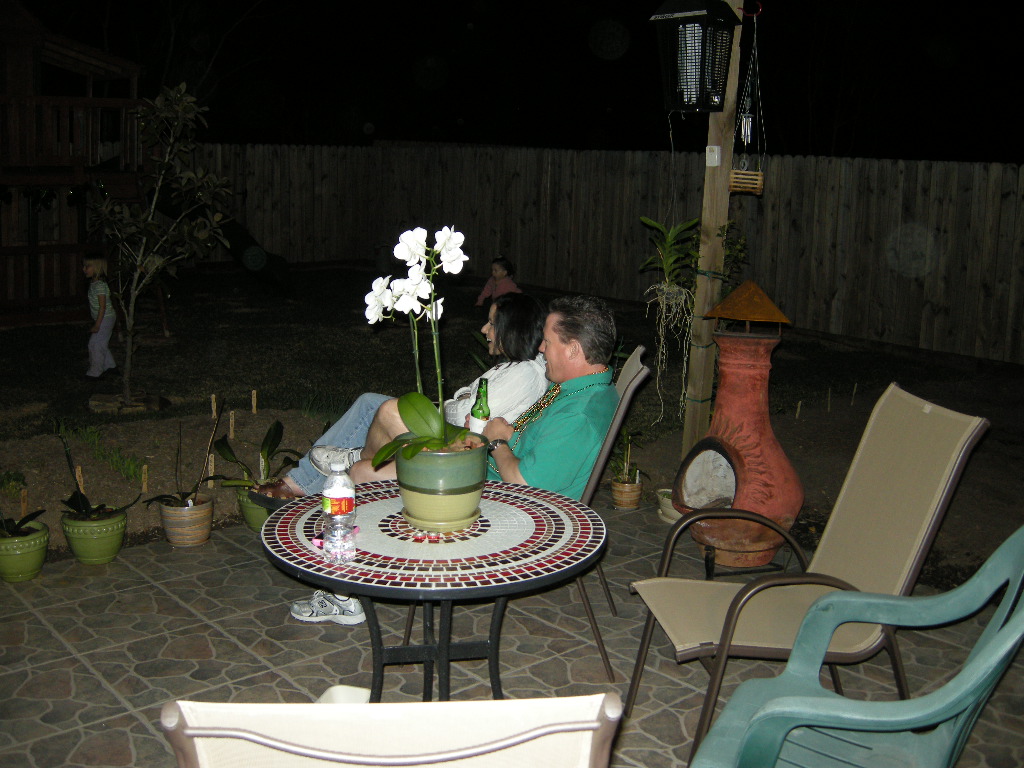
My brother (Jason) and sister-in-law (Maritza) with Brianna Carrigan (friends daughter) in the background. Orchids enjoying a nice night outside!
Subscribe to:
Posts (Atom)